


Test–Teach–Test (TTT) in ELT: A Practical Guide for CELTA, TEFL and DELTA Teachers
Learn the Test–Teach–Test framework with a 45-minute CELTA lesson plan, diagnostic teaching examples, skills applications and practical tips.
Find the gap. Bridge the gap. Then check that the bridge holds.
Imagine you spend half an hour preparing a beautiful grammar presentation. Marker sentences, timelines, concept-checking questions (CCQs), pronunciation work and practice activities are all ready.
You explain everything carefully. Only then do you discover that most of your learners already knew the language.
What a waste of teaching time!
Now try something different. Before you explain, give learners a short task and watch. Some answer confidently. Others hesitate. A few make mistakes that show you exactly what they haven't understood.
You haven't taught anything yet, but you've already made a big decision: what is actually worth teaching.
Welcome to Test–Teach–Test (TTT).
It's one of my favourite frameworks to explore with teachers on CELTA and TEFL courses. It challenges a common habit: planning what we'll say before we find out what learners need.
TTT is more than three stages on a lesson plan. It's a way of thinking.
What is the Test–Teach–Test framework?
Before you read on: in TTT, who decides what the Teach stage covers?
The learners do, through their performance in Test 1. The teacher plans everything, then teaches what Test 1 shows they need.
Test–Teach–Test is a lesson framework in three moves. Learners first try a task. The teacher uses their performance to find their needs. Then, after focused teaching, learners do another task.
The three main stages are:
- Test 1 — DiagnoseFind out what learners already know, what they partly understand and what they struggle with.
- Teach — RespondAddress the difficulties revealed by Test 1. Clarify what learners need rather than automatically teaching everything you prepared.
- Test 2 — Check progressGive learners another opportunity to use the language or skill and see what has improved and what still needs attention.
Don't be put off by the word test. There are no exams, marks or grades here. It's a diagnostic task that gives you information to guide your teaching.
That's why some teachers call it Task–Teach–Task.
The real purpose of TTT: bridging the gap
Picture learners standing at one end of a bridge. On one side is what they can already do. On the other is what they need to be able to do.
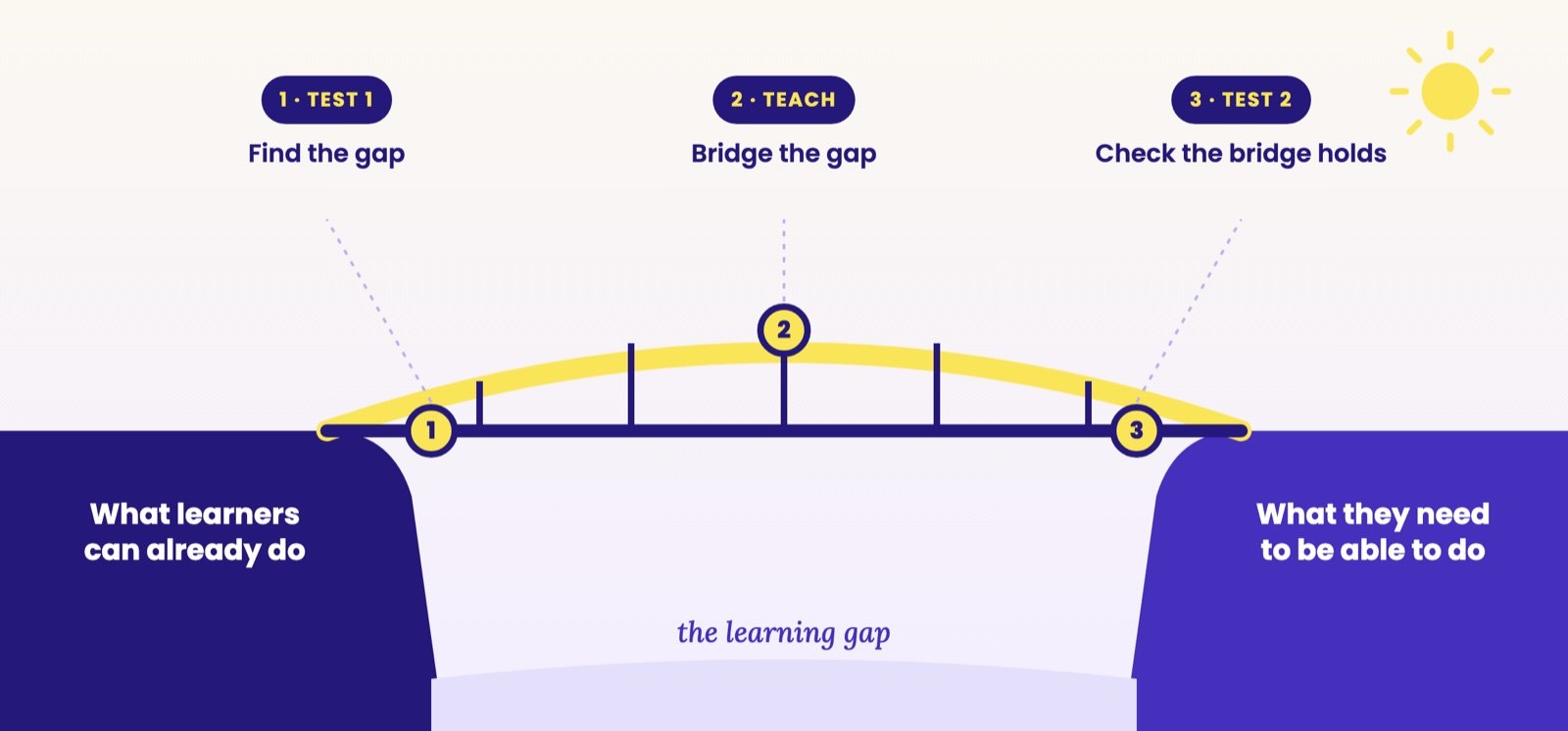
To bridge the gap, we first have to find it. That is the heart of the framework.
Test 1 shows where learners are. Teach helps them move forward. Test 2 shows whether that help made a difference.
If your Teach stage doesn't respond to what Test 1 revealed, you're not really doing TTT. You're delivering a pre-planned lesson with a test at the start.
And that's exactly where many teachers go wrong.
Test 1: Don't teach yet. Diagnose.
Say you're teaching an intermediate class. The lesson focuses on phrasal verbs for work.
You've prepared clock in, clock out, call in sick, knuckle down, slack off and lay off.
A conventional approach starts by explaining each one. But why assume all six are new?
Perhaps learners already use call in sick naturally. Perhaps they understand slack off but can't pronounce it confidently. Perhaps they confuse clock in with clock out.
You won't know until you let them show you.
So you start with a short diagnostic task. Learners might match expressions to workplace situations, or complete sentences with the right phrasal verbs.
While they work, don't explain. Your job is to observe, listen and collect evidence.
Look for more than wrong answers. Notice hesitation, guessing, avoidance and differences between learners. A correct answer doesn't always mean secure understanding.
For example, a learner might choose clock out correctly but not know if it happens at the start or end of the working day. That's useful information.
How should Test 1 work?
Start with a clear context and a task learners can manage. Let them work alone first, so you see what each person knows. Then give them a short chance to compare answers.
In feedback, confirm the correct answers and note the problem items. Don't turn every question into a mini-presentation.
Most importantly, don't spoon-feed learners during the diagnostic task. If you explain the hard language before they try it, you lose the chance to see what they can do alone.
And reassure them. You might simply say:
T: Do your best. It's fine if you don't know every answer. This activity helps me decide what we need to work on.
Test 1 is not there to embarrass learners. It is there to inform your decisions.
The Teach stage: where the real decisions happen
Same phrase. Different teaching.
knuckle down
This is the part that separates a responsive TTT lesson from a pre-planned presentation.
Before you read on: almost everyone got call in sick right in Test 1. Should you still explain it?
No. Confirm it quickly if needed and move on. Spend your time on the items learners actually got wrong.
Imagine the results look like this:
| What you noticed in Test 1 | What you might do in the Teach stage |
|---|---|
| Almost everyone understands call in sick. | Skip a full explanation; confirm quickly if necessary. |
| Several learners confuse clock in and clock out. | Clarify the difference through context and CCQs. |
| Learners know what knuckle down means but struggle to pronounce it. | Focus on pronunciation rather than re-teaching meaning. |
| Most learners misunderstand lay off. | Clarify meaning, form and pronunciation more fully. |
| Two learners make a mistake that the rest of the class does not make. | Give brief individual support or use peer explanation. |
Your lesson plan hasn't disappeared. You've simply used it intelligently.
Plan for everything. Teach what they need.
Still prepare a full language analysis before the lesson: meaning, form, pronunciation, anticipated problems and possible CCQs. But preparing it doesn't mean you must deliver every explanation.
Be ready to teach all the items. Be willing to teach only some of them.
One more point: a weak Teach stage is not always a short one. A weak Teach stage is one that misses the problems learners actually have.
If learners need clarification, give it properly. If they need pronunciation work, don't spend five minutes defining a word they already understand.
How do we clarify language without spoon-feeding?
One procedure I use in training is CECDW:
C — Context: Set up a situation that makes the meaning clear.
E — Elicit: Give learners a chance to produce or recognise the target language.
C — Concept-check: Ask focused questions to confirm understanding.
D — Drill: Model and practise pronunciation where necessary.
W — Write: Highlight the written form, including relevant spelling, grammar or lexical patterns.
For example, you're clarifying clock out. You show someone finishing their shift and recording the time.
T: What's the employee doing?
(If learners can't produce the expression, you supply it naturally.)
T: Is the employee starting or finishing work?
T: Are they recording the time?
Then you model and drill the phrase, point out any difficult sounds or stress, and show the written form.
You've covered what learners need without a long lecture.
CECDW is a useful planning sequence, not a fixed law. Adapt it to the language point, the learners and the difficulty Test 1 revealed.
Test 2: Did the bridge hold?
You've found the gaps and responded to them. But did your teaching help?
To find out, give learners another chance to perform. This is Test 2.
In our workplace lesson, learners could complete a short dialogue with the same phrasal verbs in new sentences. Then they might discuss their work experiences with a partner.
I often separate two parts:
Controlled work: Learners show more accurate understanding or use of the target language, with enough support.
Freer work: Learners use the language more independently in meaningful communication.
A controlled task might be completing a workplace conversation with the correct phrasal verbs. The freer task could use questions like these:
Have you ever had to call in sick?
When deadlines approach, do you tend to knuckle down or put things off?
What would you do if your company started laying people off?
The language stays in the lesson's context, but learners now have something meaningful to say.
Should Test 2 be identical to Test 1?
Not necessarily. It's an important planning decision.
If learners repeat the identical exercise, better results may partly come from remembering the answers.
A parallel task often tells you more. It targets the same language or skill at a similar level of challenge, but with different examples.
Repeating a task can still be useful, especially when the aim is fluency. Just be clear about what the second attempt actually tells you.
Test 2 shows immediate progress. On its own, it doesn't prove long-term learning.
And if learners are still struggling? Don't pretend the lesson worked. Revisit the difficulty, adjust your support and check again when appropriate.
TTT is a responsive cycle, not a rigid sequence that must work perfectly the first time.
A 45-minute Test–Teach–Test lesson plan
Let's turn the theory into a lesson you could actually teach.
The example is adapted from a workplace phrasal-verb lesson I planned and taught. I've simplified it so the decisions are easy to follow.
Lesson focus: Vocabulary, with speaking as a subsidiary aim
Level: Intermediate (approximately B1/B1+)
Context: The world of work
Main aim: By the end of the lesson, learners will be better able to understand and use selected workplace phrasal verbs appropriately.
Subsidiary aim: To provide opportunities for learners to discuss workplace situations and experiences.
The timings are suggestions for a 45-minute lesson, not rules of the framework.
| Stage | Time | Aim and procedure |
|---|---|---|
| Lead-in and context-setting | 4 min | Generate interest in the world of work. Learners briefly discuss what makes a good workplace or a difficult working day. |
| Test 1 — Diagnostic | 7 min | Learners complete a short workplace phrasal-verb task individually, compare answers and receive brief feedback. The teacher monitors and records difficulties. |
| Teach — Responsive clarification | 10 min | Clarify only the priority difficulties revealed by Test 1. Focus on meaning, pronunciation and form as required. |
| Test 2 — Controlled work | 7 min | Learners complete a parallel workplace task using the target expressions in a new context, then compare and check answers. |
| Test 2 — Freer practice | 11 min | Learners discuss workplace experiences in pairs, using the language where appropriate. The teacher monitors and records examples. |
| Feedback — Content and language | 6 min | Respond to learners' ideas, highlight successful language and address selected errors. |
| Total | 45 min |
What makes this plan genuinely TTT?
It's not the table. It's what happens between the second and third rows.
If Test 1 shows learners already understand half the phrasal verbs, I shouldn't explain all of them just because my slides are ready. That time can go to the problem items, better practice or more meaningful communication.
If learners understand the meanings but struggle with word order or pronunciation, my clarification should change too.
The framework is built around learners' needs, not the teacher's slides.
One practical warning: protect Test 2 and the final feedback. A long Teach stage that leaves no time to use the language defeats much of the purpose.
TTT for reading, listening, speaking and writing
Yes, you can. And it's one of the most overlooked uses of the framework.
Teachers often link Test–Teach–Test with grammar or vocabulary only. But the same diagnostic logic works for skills too.
In a systems lesson, you may be diagnosing problems with meaning, pronunciation or form.
In a skills lesson, the problem may be a sub-skill, strategy, genre convention or the language needed to do a task.
The question stays the same: What can learners already do, and what is stopping them from doing better?
Example 1: TTT for reading sub-skills
I used this diagnostic thinking in my DELTA Module Two work to develop learners' reading sub-skills.
Imagine your learners need to get better at reading for gist.
Test 1: Give learners a short article and a limited time to choose the best summary or headline.
As you monitor, you notice several learners trying to understand every unfamiliar word. They spend too long on single sentences and miss the main idea.
Teach: Respond to that difficulty. Model a more purposeful way to read for gist. Show learners how to use the title, the opening sentences and the text's overall organisation to get the general meaning, without stopping at every unknown word.
Test 2: Give learners a different text of similar difficulty and a similar gist task.
Now look at both their answers and their approach. Did they find the main idea more successfully? Did they rely less on word-by-word decoding? Can they explain how they did the task?
This is much more useful than giving two reading exercises and hoping reading improves.
A key point for CELTA and DELTA teachers: TTT can shape the cycle inside a receptive-skills lesson; it doesn't mean you drop necessary pre-reading, while-reading or post-reading work. Use it when a diagnostic first attempt suits the aim and the learners.
Example 2: TTT for writing genres
Now a different situation. Your learners need to write a formal email requesting information.
Test 1: Ask them to write a short email to a training centre asking about course dates, fees and entry requirements.
You review their emails. Perhaps the grammar is fairly accurate, but there's no suitable opening and closing. The information is poorly organised. The register is too informal for the reader.
Teach: Don't give a general grammar lesson. Work on the weaknesses you saw. Use a short model email to highlight purpose, audience, organisation and suitable language choices.
Test 2: Give learners a similar writing situation, or ask them to redraft using clear success criteria. Then check their work against those criteria.
Is the organisation better? Is the register more appropriate? Can the reader find the information more easily?
This is TTT for genre awareness and writing development, not just grammar correction.
The same thinking can support listening tasks, spoken interaction, functional language and other carefully chosen skills aims.
Same framework. Different gap.
TTT or PPP: Which is better?
Neither framework is automatically better.
PPP (Presentation–Practice–Production) starts with planned language clarification and moves towards more independent use.
TTT (Test–Teach–Test) starts with evidence of learner performance and uses it to decide the focus of teaching.
- Have learners met this language or skill before?Yes → TTT may suit: go to the next question.No, and they have no real chance with the first task → a Teach-first approach (e.g. PPP) may be better.
- Is their knowledge uneven, or do you need to find specific areas to work on?Yes → TTT is particularly useful.No → choose the framework whose logic best fits the lesson aim.
Don't choose a framework because it looks more advanced on your lesson plan. Choose it because its logic helps your learners achieve the lesson aim.
If you're preparing for CELTA or DELTA, be ready to justify your decisions, not just name the framework.
Common TTT mistakes I see in teaching practice
1. Throwing learners in at the deep end.
Test 1 is too hard, so almost everyone fails, and the teacher learns little. Make the task accessible enough to show differences in what learners know and can do.
2. Teaching everything anyway.
Learners already know several items, but the teacher still presents every slide. Prepare thoroughly, then respond selectively.
3. Teaching during Test 1 feedback.
Every answer triggers an explanation before the diagnostic picture is clear. Keep the first feedback short and save clarification for the Teach stage.
4. Making the Teach stage a lecture.
The teacher explains rules for ten minutes without checking understanding or tackling the real difficulties. Use clarification in context, guided elicitation, CCQs and targeted pronunciation or form work.
5. Treating Test 2 as an optional extra.
The Teach stage runs over, and learners never get a real chance to try again. Protect time for the second attempt.
6. Ignoring learners' performance in freer practice.
The teacher ends the speaking task with “Well done, everyone!” and moves on. Give content feedback, highlight successful language, then deal with a few useful errors.
Behind all six is the same problem: the teacher follows the plan without responding enough to the learners.
Why TTT is more than a lesson framework
There's a reason I keep coming back to this approach in teacher training. It makes teachers better observers.
Before explaining, you ask what learners already know.
Before correcting, you listen for the actual difficulty.
Before deciding your teaching worked, you look at what learners can now do.
This links closely to formative assessment: information about learning is useful when it helps us adjust teaching and learning. The research on formative assessment supports responsive teaching decisions. It should not be read as proof that one three-stage lesson shape is always better.
And this thinking shouldn't stop when the lesson ends. It belongs in lesson planning, monitoring, feedback, teacher development and reflection.
Find the gap. Bridge the gap. Then check that the bridge holds.
Perhaps the best question for your next lesson isn't “What am I going to teach?”
It's “What do my learners need me to teach, and how will I know?”
Try it in your next lesson
Choose a language point or sub-skill your learners have met before.
Prepare a short task that shows what they can already do. While they work, note the difficulties you actually see. Use those notes to decide what deserves your attention.
Then give learners another meaningful chance to perform.
Afterwards, ask yourself:
Did I teach the lesson I had planned, or the lesson my learners needed?
Continue learning with Lumina
This article builds on an input session used in Lumina's teacher-training programmes.
You can also explore Lumina's Practical TEFL / TESOL programme, where lesson frameworks are studied through demonstrations, planning and teaching practice, or browse the YALA ELT Community for further resources.
Quick answers about Test–Teach–Test
What does TTT stand for in ELT?
In lesson-framework discussions, TTT stands for Test–Teach–Test. In other contexts, particularly when discussing classroom interaction, TTT can mean Teacher Talking Time. The two terms describe different things.
Is TTT suitable for CELTA lessons?
Yes, when the framework supports the lesson aim and learners' existing knowledge. Tutors will be interested in how effectively Test 1 informs the Teach stage and whether learners get an appropriate opportunity to apply what they've learned.
Can TTT be used for grammar and vocabulary?
Yes. It is commonly used to diagnose and address gaps in learners' understanding or use of language systems, including grammar, vocabulary and functional language.
Can TTT be used for reading and writing?
Yes. A diagnostic task can reveal a difficulty with a reading sub-skill, writing strategy or genre feature. The teacher then provides targeted support before learners attempt a comparable task.
What is the most important stage in TTT?
All three stages matter, but the relationship between Test 1 and Teach is crucial. If the teaching does not respond to the diagnosis, the framework loses its defining purpose.
Further reading: Black, P., & Wiliam, D. (2009). Developing the theory of formative assessment. Educational Assessment, Evaluation and Accountability, 21, 5–31.
Check your understanding
6 short questions. No account needed, no score, and nothing you choose or write is saved or sent anywhere.
Show the answer (no automatic checking)
Answer: C. TTT is about responding to diagnosed needs. Preparing six items doesn't mean you have to teach all six.
By Lumina Trainers
Show the answer (no automatic checking)
Answer: D. A correct answer is useful evidence, but it may not establish secure understanding. A brief CCQ or another example can help.
By Lumina Trainers
Show the answer (no automatic checking)
Answer: 1–B, 2–A, 3–D, 4–C.
By Lumina Trainers
Show the answer (no automatic checking)
Answer: B. Parallel tasks are often more informative because they assess comparable knowledge or skills in a different example. Task repetition can still be useful, depending on the aim.
By Lumina Trainers
5 You planned a TTT lesson on workplace vocabulary, but Test 1 reveals that your learners know most of the target expressions. What would you do next, and why?
Show a suggested answer
I would briefly confirm any uncertain items, then focus the Teach stage on the expressions learners still find difficult. I might use the time saved for additional meaningful practice or feedback. My decisions should come from the diagnostic evidence, not simply from the number of slides I prepared.
Suggested answer by Lumina Trainers
6 How could you apply the TTT principle to help learners improve their reading-for-gist skills?
Show a suggested answer
I could begin with a short gist-reading task and observe learners' performance and reading approach. If the evidence suggests that learners are reading word by word and losing sight of the main idea, I could model a more effective gist-reading strategy. They could then attempt a comparable task using a different text, allowing me to examine whether their approach and performance improved.
Suggested answer by Lumina Trainers
Ahmed Bin NasserCELTA Tutor & Teacher Trainer | Lumina